
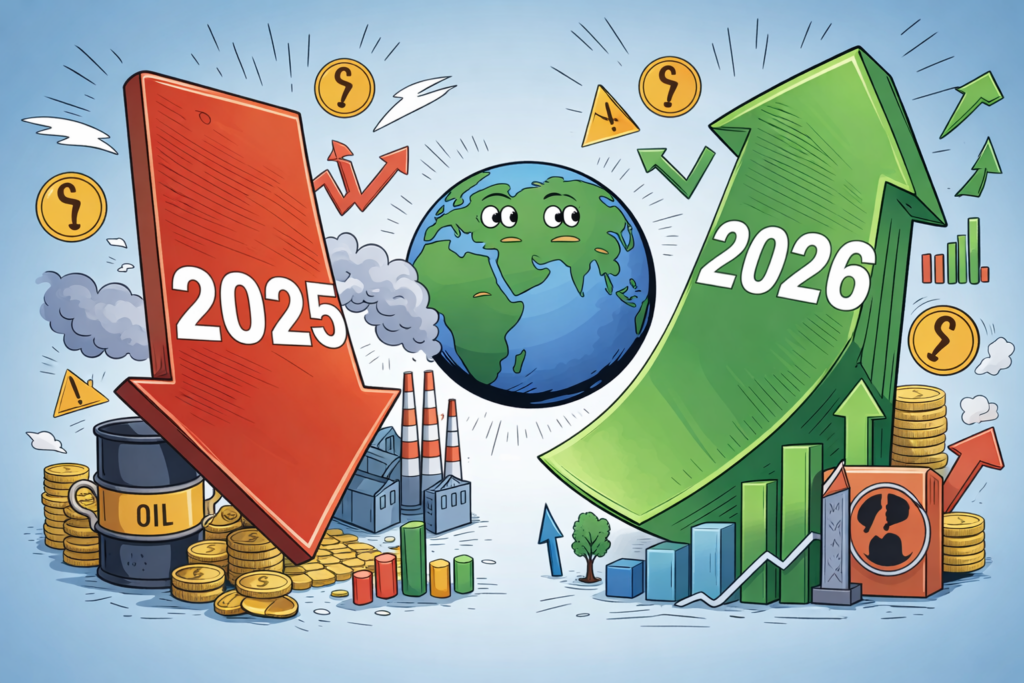
Introduction: A Year of Unprecedented Shifts
The year 2025 will be remembered in economic history as one marked by structural shifts, geopolitical disruptions, and persistent uncertainty. From trade policy to global growth dynamics, financial markets and policymakers faced challenges rarely seen in recent decades.
As we enter 2026 — just days after major geopolitical developments, including a U.S. military intervention in Venezuela and the detention of Nicolás Maduro — it’s critical to understand how 2025 shaped today’s economic landscape and what key trends are likely to influence the year ahead.
1. Global Growth: Modest Expansion and Lingering Fragilities
Despite high expectations, global economic growth in 2025 was modest and uneven.
According to international forecasts, the world economy expanded at a subdued pace, with projections around 3.2% in 2025 and a slight deceleration expected in 2026. Advanced economies continued to lag, while emerging markets — notably in Asia — contributed disproportionately to global growth. IMF
Persistent trade barriers and policy uncertainty weighed on activity, while inflation pressures eased but did not disappear entirely. Risks such as geopolitical tensions and uneven recovery across regions remained notable headwinds. worldbank.org
2. Trade Policy and Protectionism Redefined Market Structures
One of the most defining economic developments of 2025 was the permanent shift in trade policy, particularly in the United States.
The year became known in financial circles as an era of “America First 2.0,” where trade protectionism moved from a campaign slogan into a core element of federal economic strategy. Widespread tariffs reshaped supply chains, discouraged global integration, and prompted a reorientation toward domestic and regional sourcing — a phenomenon some analysts have termed the “North American Fortress” model. FinancialContent
While equity markets ultimately ended 2025 higher — with the S&P 500 posting strong returns amid volatility — the internal mechanics of market performance shifted significantly under these new trade dynamics. FinancialContent
3. Corporate Strain and Bankruptcy Trends
The stress from high tariffs, inflationary pressures, and supply chain disruptions was not evenly distributed. Corporate fragility increased significantly:
In 2025, more than 700 U.S. companies filed for bankruptcy, a 14% rise over the previous year, marking the highest business failure rate since the Great Recession. New York Post
Key sectors such as manufacturing, construction, and transportation were particularly affected, as higher input costs and constrained demand squeezed margins and capital access.
4. Commodity Market Dynamics: Oil’s Unusual Downturn
After years of volatility, global oil prices experienced one of their steepest annual declines since the COVID-19 era. Oversupply amid weaker demand — partly tied to economic slowdown in China and other major importers — contributed to this drop. The Guardian
Lower oil prices can, in theory, ease inflationary pressures for consumers. However, retail fuel prices remained stubbornly high in many markets, reflecting persistent cost pass-through and infrastructure price dynamics.
5. Emerging Markets: India and Vietnam Highlight Growth Pockets
Not all regions struggled in 2025. In Asia, India surpassed Japan to become the world’s fourth-largest economy, a historic milestone reflecting robust economic fundamentals and sustained growth, even amid global uncertainty. marketwatch.com
Similarly, Vietnam posted strong GDP gains, underpinned by rising trade revenues and foreign investment, positioning it among Asia’s fastest-growing markets. vietnamnews.vn
These contrasts highlight the divergent nature of the global recovery — where growth hubs coexisted with stagnation in other advanced economies.
6. Geopolitical Turbulence and Economic Risks
Beyond trade policy, 2025 witnessed sharp geopolitical disruptions with economic implications. While not as widely documented in mainstream economic forecasts, conflicts and sanctions in multiple regions contributed to currency instability, inflationary spikes, and supply disruptions — especially regarding energy and food markets.
Recent protests in Iran driven by severe inflation and currency collapse illustrate how economic distress and political instability intersect, with broader implications for regional trade and energy supplies. Wikipedia
These events — coupled with major U.S. action in Venezuela at the end of the year — are likely to reverberate through commodity markets, investment flows, and risk premia in 2026.
7. Monetary Policy and Inflation: A Gradual Normalization
A key economic thread throughout 2025 was the gradual normalization of monetary policy following the intense inflationary period of 2021–2023. Central banks in advanced economies remained cautious but committed to inflation targets, even as growth slowed. Capital Economics
In the United States, ongoing debate over Federal Reserve independence and rate policy continued to influence markets — though equities and bond yields remained surprisingly resilient even amid political pressure. Reuters
What to Expect in 2026: Key Economic Themes
As 2026 begins, several trends clearly emerging from 2025 will shape the year ahead:
1. Continued Deceleration in Global Growth
Most major forecasts point to slower global expansion in 2026 than in 2025, with inflation continuing its gradual decline but remaining above pre-pandemic targets in several economies. OECD
2. Trade Policy’s Lingering Effects
Protectionist measures and tariff regimes will continue to influence production costs, investment decisions, and the structure of global supply chains. Firms are likely to adjust operational footprints further to mitigate policy risk.
3. Geopolitical Risk Premiums
With significant geopolitical events already unfolding, investors will price geopolitical risk more explicitly in asset valuations, particularly in energy, commodities, and defense sectors.
4. Divergence Between Growth Markets and Advanced Economies
Emerging markets with strong demographic trends and investment climates — particularly in Asia — are expected to outperform advanced economies in headline growth metrics.
5. Consumer and Labor Dynamics in Focus
Slower consumer spending and evolving labor market conditions — including potential shifts due to demographic trends and migration — will be central to real GDP projections and monetary policy responses.
Conclusion: 2025’s Legacy and 2026’s Outlook
The economic story of 2025 was one of adaptation in the face of structural change. Geopolitical risk, trade fragmentation, corporate stress, and shifting centers of growth defined a challenging but transformative year.
As 2026 unfolds, the legacy of these forces — from global growth moderation to tariff-driven market shifts — will inform investment strategies, policy debates, and business decisions worldwide. The balance between risk and opportunity remains delicate, and the global economy is likely to navigate another year of uncertainty and adjustment.