
Introduction: A Geopolitical Event With Economic Spillovers
In the first days of 2026, global markets reacted to reports of U.S. military action in Venezuela followed by the detention of Nicolás Maduro.
Regardless of political interpretation, the event represents a sudden institutional and economic disruption in a country that, despite years of decline, still holds strategic relevance — particularly in energy markets.
For investors and analysts, the key question is not political legitimacy, but economic impact:
How does this affect oil, emerging markets, capital flows, and global risk perception in 2026?
Venezuela’s Economic Relevance: Smaller Economy, Large Strategic Weight
Venezuela is no longer a major global economy by output. However, it retains outsized importance due to:
- the world’s largest proven oil reserves
- its potential production recovery capacity
- its role in regional energy and trade expectations
This makes Venezuela economically relevant not for what it produces today, but for what it could produce under different institutional conditions.
Immediate Economic Effects Observed
1. Market Volatility and Risk Repricing
The immediate reaction in global markets was a temporary increase in risk aversion, particularly toward:
- emerging market assets
- Latin American currencies
- energy-related equities
Such reactions are typical after abrupt geopolitical events and reflect uncertainty rather than fundamental change.
2. Oil Price Sensitivity
Oil prices showed short-term volatility, driven less by current Venezuelan supply and more by future expectations.
Markets are now assessing:
- whether Venezuelan production could eventually return to global markets
- under what legal and regulatory framework
- and how quickly this could happen
This uncertainty introduces both upside and downside risks to energy prices in 2026.
Potential Positive Economic Implications for 2026
From a strictly economic perspective, several positive scenarios exist:
1. Path Toward Market Reopening
If the situation leads to:
- institutional clarification
- revised sanctions frameworks
- improved legal certainty
Venezuela could gradually re-enter parts of the global economy, particularly in energy.
This would:
- increase long-term oil supply expectations
- reduce structural tightness in energy markets
- lower inflationary pressure tied to energy costs
2. Investment and Reconstruction Potential
In the medium term, a transition period could create:
- reconstruction demand
- infrastructure investment opportunities
- regional trade normalization
While not immediate, such dynamics are economically relevant for 2026–2027 outlooks.
Negative and Risk-Oriented Economic Consequences
At the same time, significant downside risks remain:
1. Prolonged Uncertainty
If governance and legal clarity are delayed, Venezuela may face:
- frozen capital flows
- limited access to international finance
- stalled economic recovery
Markets tend to penalize uncertainty more than negative certainty.
2. Regional Risk Perception
Even if contained, the event reinforces the idea that political risk remains present in emerging markets, increasing risk premiums and borrowing costs across the region.
3. Short-Term Supply Disruptions
Operational instability can delay any potential increase in oil output, keeping global energy markets tighter than expected in early 2026.
Global Economic Impact: Limited but Non-Negligible
From a global standpoint, the economic impact is manageable, but not irrelevant.
- Venezuela alone will not redefine global growth
- but it can influence energy prices, inflation expectations, and market sentiment
- especially in a year where global growth is already projected to slow
The event adds another variable to an already complex 2026 macroeconomic environment.
What to Watch in 2026 (Economic Lens Only)
Key indicators to monitor:
- oil production data and export licenses
- sanctions policy adjustments
- capital flow signals into Latin America
- energy price stability vs. volatility
- emerging market risk premiums
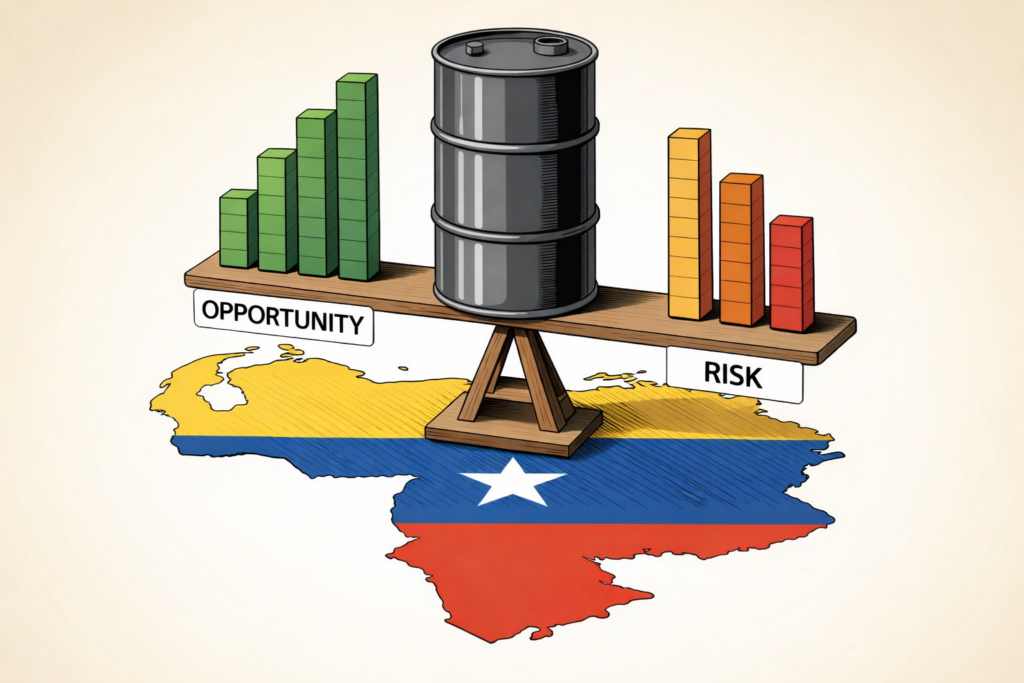
These factors will determine whether the situation evolves into an economic opportunity, a neutral adjustment, or a persistent risk factor.
Conclusion: An Economic Event, Not Just a Political One
The U.S. action and the detention of Nicolás Maduro represent a political shock with real economic consequences, both positive and negative.
For 2026, the most likely outcome is heightened short-term uncertainty, followed by a gradual reassessment as institutional clarity improves or deteriorates.
From an economic perspective, the situation underscores a recurring lesson:
markets respond less to events themselves and more to the clarity that follows them.
Whether Venezuela becomes a stabilizing factor or a continued source of volatility in 2026 will depend not on ideology, but on economic governance, legal structure, and execution.