
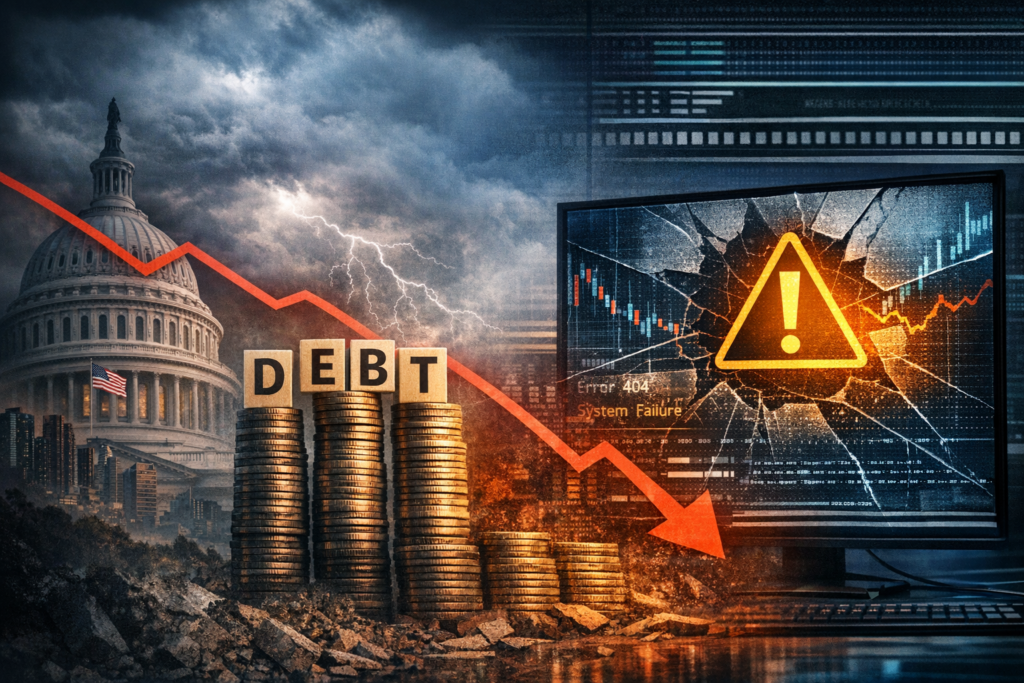
What happens when national debt exceeds model limits — can large economies “crash” like software?
In software engineering, systems don’t usually fail because of a single bug.
They fail when assumptions silently break, limits are exceeded, and edge cases become the norm.
National economies don’t “crash” in the same way software does — but the analogy is still useful.
Especially when public debt grows beyond the range most economic models were designed to handle.
This post explains what actually happens when national debt exceeds model limits — and what does not happen.
1. What “model limits” really mean in economics
Economic models are simplified representations of reality.
Most mainstream public-debt models assume:
- stable institutional capacity,
- functioning capital markets,
- continued demand for government bonds,
- and policy flexibility (monetary, fiscal, regulatory).
These models work well within a certain range of debt levels and macro conditions.
But like software tested only under “normal load,” models become unreliable when:
- debt levels stay elevated for long periods,
- interest costs rise faster than growth,
- political constraints reduce policy options,
- or external shocks persist instead of fading.
Exceeding model limits does not mean the economy immediately collapses.
It means predictions become less reliable.
2. Why large economies don’t “crash” like software
A software crash is binary: the system stops.
A national economy is adaptive:
- policies adjust,
- institutions change,
- behaviors shift,
- and outcomes degrade gradually rather than abruptly.
Large economies also benefit from:
- deep capital markets,
- reserve currency status (in some cases),
- and the ability to roll over debt for long periods.
This is why high-debt economies can operate for decades without a sudden failure.
There is no equivalent of a “segmentation fault” for GDP.
3. So what actually breaks first?
When debt exceeds the comfortable range of existing models, secondary effects appear — not an immediate collapse.
Common stress points include:
a) Policy constraints
High debt reduces fiscal flexibility.
Governments become more sensitive to interest rates, market sentiment, and inflation dynamics.
Policy becomes reactive rather than proactive.
b) Model error accumulation
Forecast errors compound.
Debt-sustainability projections rely on small differences between growth and interest rates — small errors can lead to large long-term misestimates.
c) Incentive distortions
Political incentives may shift toward short-term stabilization rather than long-term optimization.
This is not a moral failure — it’s a structural one.
4. Why debt crises look “unexpected” in hindsight
Most sovereign debt crises don’t happen because debt is high.
They happen because something else changes while debt is already high.
Typical triggers:
- a growth slowdown,
- a sudden rise in real interest rates,
- external financing constraints,
- or institutional credibility shocks.
High debt acts like reduced system headroom.
The shock causes the failure, not the debt alone.
This is similar to software that runs fine at 90% memory usage — until one unexpected process appears.
5. The biggest misconception: “models predicted this”
After crises, it’s common to say:
“The models were wrong.”
More accurately:
The models were used outside the conditions they were built for.
Models are tools, not guarantees.
They don’t fail — expectations do.
6. Can large economies “crash”?
Not in the software sense.
What they experience instead:
- prolonged stagnation,
- financial repression,
- inflationary erosion of liabilities,
- or gradual institutional degradation.
These outcomes feel slow, confusing, and politically contested — not sudden or cinematic.
Which is why they are harder to anticipate and harder to fix.
7. A more realistic framework
Instead of asking:
“Will debt cause a crash?”
A better question is:
“How does high debt change the system’s tolerance for shocks?”
Key variables to watch:
- interest-growth differentials,
- debt maturity structure,
- institutional credibility,
- and policy optionality.
Debt is not a kill switch.
It’s a constraint amplifier.
Conclusion
National economies don’t crash like software.
But when debt exceeds the limits of standard models, uncertainty rises — not because collapse is inevitable, but because the system is operating in a regime with fewer degrees of freedom.
The danger is not sudden failure.
The danger is believing that old models still provide precise answers in a new operating environment.
What economic assumptions do you think are most likely to fail first in high-debt regimes — and why?